Nfl Replay Review Incontrovertible Evidence on Scoring Plays
History of Instant Replay
Upon further review…
The NFL's instant replay debate has been a hot-button topic since games were commencement regularly televised in the belatedly 1940s. Traditionalists, hesitant to interfere with the purity of the game by removing human error, clashed with those eager to embrace technology and all that it offered the game.
The NFL has come to cover instant replay, simply the process that led to the state-of-the-art system the league uses today was not always seamless. The history of instant replay in professional football is filled with stops and starts; missteps and controversy; and modifications and improvements that continue to this 24-hour interval.
Instant replay's history begins in hostage four decades ago — with a man and a stopwatch.
STOPWATCHES AND VIDEO CAMERAS
The NFL kickoff experimented with instant replay in 1976 when Fine art McNally, so the managing director of officiating, wanted to discover out how long a video review would delay a game. Equipped with a stopwatch and video camera, he observed a "Mon Night Football game" contest between the Dallas Cowboys and Buffalo Bills from a press box inside the stadium.
"If there was any question, we took a look at information technology," McNally said after the experiment. "We asked the camera technicians to requite us different angles."
He saw a missed call on a play involving O.J. Simpson that could have been corrected with replay review. McNally knew then: Replay could assistance football.

The NFL tested instant replay during the 1978 Hall of Fame game and half-dozen other preseason games that year. It determined the system was not still ready for regular-season games. (AP Photo/Rusty Kennedy)
2 years later, the league beginning tested instant replay on a wider calibration during seven nationally televised preseason games, starting with the 1978 Hall of Fame game betwixt the Philadelphia Eagles and Miami Dolphins.
The system'southward performance was lackluster. The applied science was too costly to install at every stadium, the system needed more cameras than broadcasters used for games at the time, and calls remained inconclusive later on lengthy reviews. It was clear instant replay was years away from being implemented full time.
"Nosotros all the same think we need a minimum of 12 cameras to become all the angles on every play," then-assistant supervisor of officials Nick Skorich said after that first game. "Electronically, I don't know if we are advanced enough however."
Unwilling to implement a costly and ineffective system, the league shelved instant replay until the mid-1980s.
INITIAL INSTANT REPLAY: 1985–1992
Less than a decade after McNally's experiment, momentum for an instant replay arrangement once over again began to build.
The NFL tested a review arrangement during eight preseason games in 1985 — producing promising results.
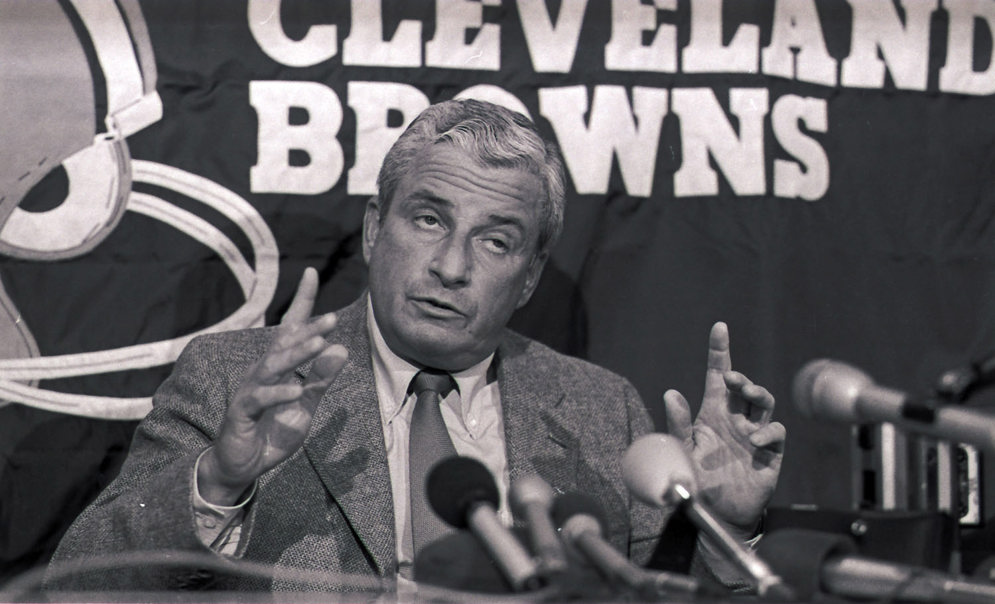
Cleveland Browns owner Fine art Modell delivers a message during a 1982 news conference. (AP Photo/Mark Duncan)
"The affair we learned in the preseason is that nosotros can get the logistical things washed," NFL Director of Administration Joe Rhein said. "That is, information technology's possible to review instant replays [in the press box] and get the word to the referee on the field without a pregnant loss of fourth dimension."
The system performed so well that owners held an unprecedented vote to determine if the league would use instant replay in the upcoming playoffs — even though the system had never been used in the regular season. The motion failed narrowly, only the close determination fabricated it clear the league's leaders were once again warming upward to the technology.
"[Owners] didn't want a playoff game decided past a bad call, and and then they tried to push it through right there," Art Modell, Cleveland Browns owner, said after the vote. "But that was a picayune too quick for some people."
"Some clubs may have voted against it at the time because information technology was adding something for the postseason that was not bachelor during the regular flavour," NFL spokesman Joe Browne said at the time.
In the proposed 1985 system, a replay official would have monitored the game feed from an in-stadium berth and initiated all reviews, reversing a call merely with "indisputable visual evidence."
Prior to the 1986 season, the owners voted 23-four-one — 21 votes were needed to pass — to adopt express utilize of instant replay in the upcoming year. The initial process lacked the coach'due south challenges and technology familiar to today's fans. Nearly reviews were initiated upstairs by the replay official, except when game officials requested a review of their ruling after conferring on the field.
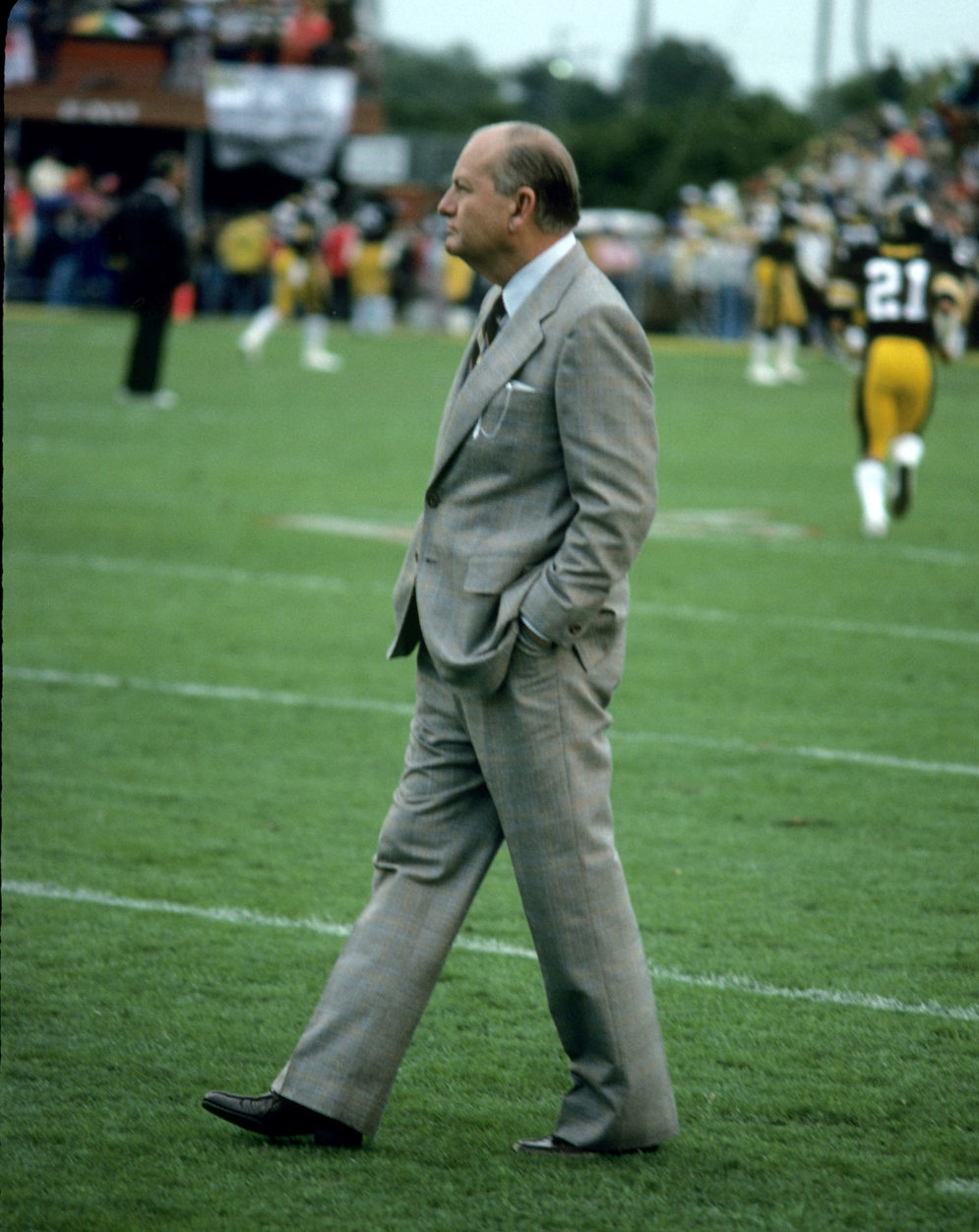
Dallas Cowboys president and general director Tex Schramm stalks the sidelines before Super Bowl XIII, a 35-31 loss to the Pittsburgh Steelers on Jan. 21, 1979. (AP Photo/NFL Photos)
Reviewable plays during instant replay's first installation included:
- Plays of possession or touching (fumbles, interceptions, receptions, muffs, or ineligible role player touching a forward pass);
- Almost plays governed past the sidelines, goal lines, finish lines and line of scrimmage (whether a player is out of premises, forrard or backward passes or breaking the plane of the goal line);
- And easily detectable infractions on replay (as well many men on the field).
The decision was merely reached after a spirited fence and concessions to appease skeptics. The compromise: The organization would be guaranteed for only i yr and would accept to be voted on again during the following offseason.
"Some feel nosotros are taking the man element out of the game and moving it to a booth in the press box," said Tex Schramm, who then served as Dallas Cowboys general manager and NFL Competition Committee chairman.
Replay officials sat in a booth in the stadium with two nine-inch television monitors showing the broadcast feed and two videocassette recorders. The two VCRs were capable of recording and immediately replaying individual plays. Reviews would be a maximum of 2 minutes, timed from the moment when the umpire signaled timeout.
First utilize of instant replay in 1986 Week 1 between the Browns and Bears.
Instant replay's first regular season saw an average of 1.6 reviews per game. Of those plays in question — 374 in all — only 10 percent concluded with a reversal of the ruling on the field.
The owners reapproved instant replay for the next season. Barely. The measure got exactly the 21 votes needed to laissez passer (21-vii) and was accepted with a few minor tweaks. Merely just like the 1986 decision, the arrangement would accept to be approved again the following offseason.
Some adjustments were made in an try to improve the system. To ensure replay officials were experts on the technology, the NFL would at present hold a preparation dispensary each offseason. The equipment improved every bit well, albeit slightly, as review monitors were upgraded — from nine inches to 12 inches.
"I'm confident the arrangement will get better and amend," Hall of Fame Miami Dolphins coach Don Shula said after the '87 vote. "As coaches, we realized we can't run across a game from the sidelines as well as our coaches can from upstairs in the press box. If you transmit that same thinking to officials, it helps them too."
BUMPS IN THE ROAD
The first organization did not lack controversies — or critics.
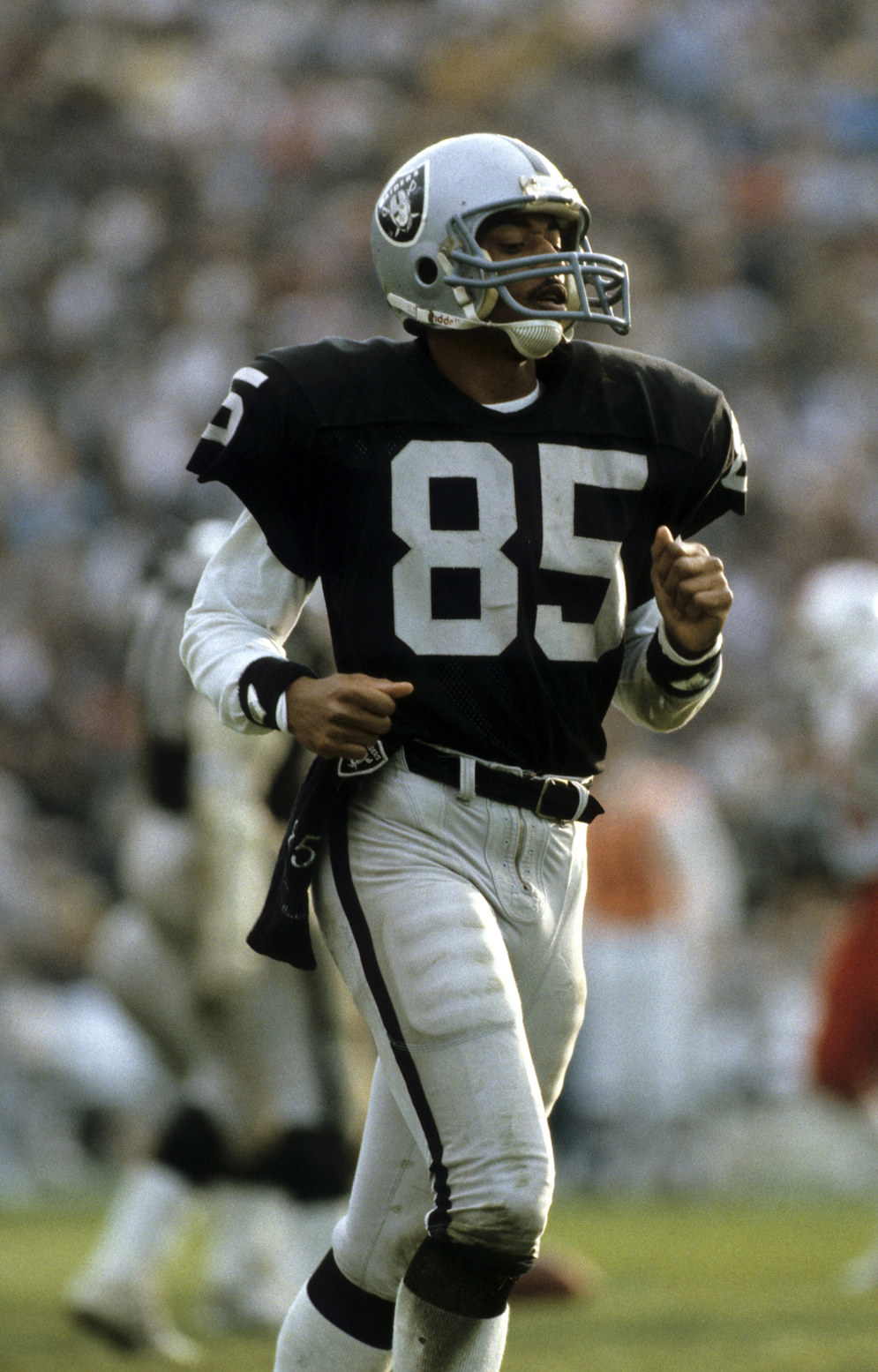
A miscommunicated instant replay phone call in October 1986 awarded Oakland Raiders receiver Dokie Williams a touchdown on a play that should have been ruled an incomplete pass. (AP Photo/NFL Photos)
During a Kansas Urban center Chiefs and Oakland Raiders game in October 1986, Raiders quarterback Marc Wilson threw a pass to Dokie Williams in the corner of the end zone tardily in the first half. The on-field officials ruled the play a touchdown. Just up in the instant replay booth Jack Reader, assistant supervisor of officials, adamant it was incomplete.
"Pass incomplete," Reader told umpire John Keck with the walkie-talkies used for instant replay system communication.
"Pass is consummate," Keck heard. Inadvertently, the touchdown stood. The Raiders won by a touchdown — 24-17.
"My buddy, the instant replay guy," Williams jokingly said later the game.
But the miscommunication was no laughing matter to the NFL. The league replaced its walkie-talkies with pagers and radio headsets and it changed the terminology, using clearer terms like "confirmed" and "reversed."
NFL Commissioner Paul Tagliabue, long a proponent of instant replay, was eager to improve the arrangement.
"I'm hopeful we tin brand some modifications and keep the concept and brand it work rather than stride back out of the electronic historic period," he said in 1990.
The commissioner'south hopes were dashed. Later a half-dozen-flavor run, instant replay met its demise in 1991 when 17 owners voted against renewing the arrangement. The conventionalities: The arrangement delayed games too much and failed to get enough of the calls correct.
| Year | Games | Plays Reviewed | Reversals |
| 1986 | 224 | 374 (1.6 per game) | 38 (10%) |
| 1987 | 210 | 490 (two.3 per game) | 57 (eleven.half dozen%) |
| 1988 | 224 | 537 (two.3 per game) | 53 (9.8%) |
| 1989 | 224 | 492 (2.1 per game) | 65 (13%) |
| 1990 | 224 | 504 (2.two per game) | 73 (14.4%) |
| 1991 | 224 | 570 (two.5 per game) | 90 (fifteen.seven%) |
| 1986–1991 | i,330 | 2,967 (2.2 per game) | 376 (12.6%) |
"Basically, it was a nifty theory that didn't work in practise," said Norman Braman, owner of the Philadelphia Eagles.
Other owners, like New Orleans Saints President and NFL Contest Committee Chairman Jim Finks, believed the system should accept been improved rather than tossed away.
"I personally feel it is a major step backwards," Finkssaid. "At that place will be much more pressure on the guy on the field."
Ultimately, the system's ineffectiveness led to the terminate of its use. The league determined that nine of the ninety reviewed calls in 1991 were overturned incorrectly. And only 13 percent of the full plays reviewed from 1986 to 1991 were reversed, fueling critic's arguments that this was non the correct system.
REPLAY REVISITED: A CLOSER LOOK AT AN IMPROVED SYSTEM
The debate over instant replay, which never completely concluded, picked upward again in the mid-'90s.
Many of the league's caput coaches at the fourth dimension did not take immediate experience with the previous version, then they were curious about how an improved organisation would work.
"My sense is that everybody feels that if we're going to have replay, we should look for a concept that works," Tagliabue said in 1996. "But we want to do information technology right."
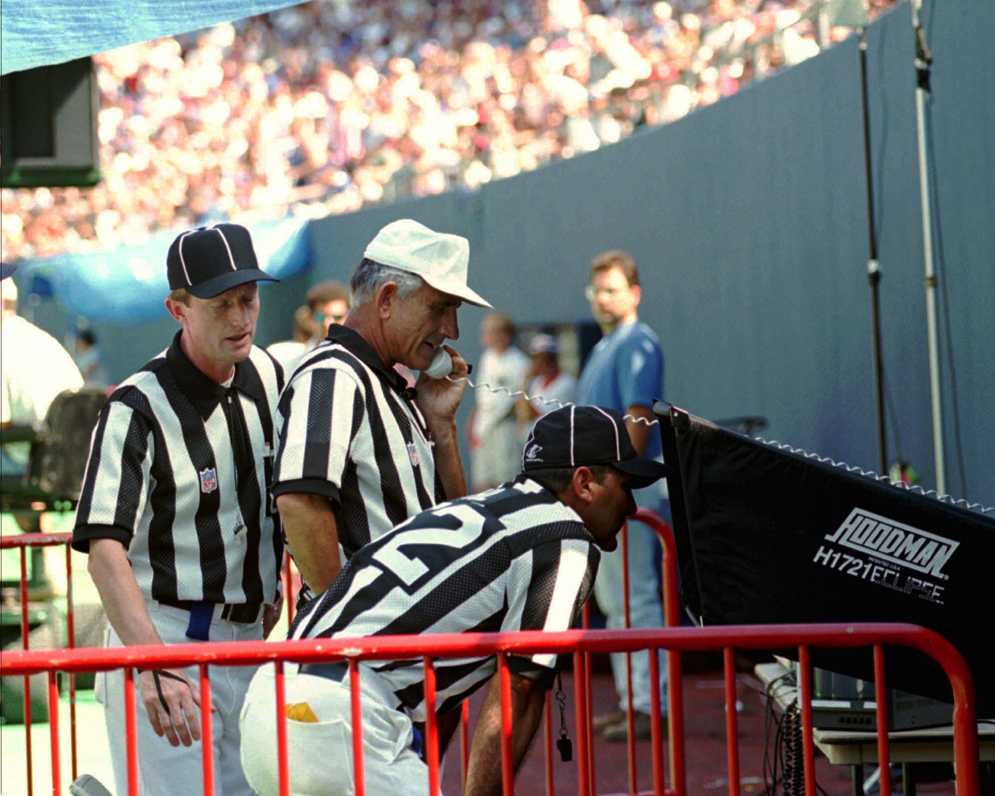
Referee Bob McElwee reviews a play with an on-field monitor during the 1996 preseason testing of the new system. (AP Photograph/Bill Kostroun)
A new system was approved for testing in 10 preseason games in 1996. Coaches could challenge rulings on the field and replay now covered three categories of plays: out of bounds, number of players on the field and scoring plays.
Each motorbus could challenge 3 plays per half — at the cost of a timeout per review. The league went away from the erstwhile version of replay officials in skyboxes and gave referees the authority to review plays on the field inside a booth equipped with monitors. And referees now had only 90 seconds to make their ruling.
Despite the changes, owners voted against implementation for the 1997 regular flavour. The master hang-upwards centered on each review costing teams a timeout, fifty-fifty when a challenge was successful.
Heading into the 1999 season, the Competition Committee again adjusted its proposal to accost owners' and coaches' concerns. Voters responded, overwhelmingly approval the new arrangement 28-3. Instant replay review was back in the NFL.
The new organization addressed some of the chief criticisms of past versions.
- To minimize delays, the league cut the number of challenges from three to two per one-half.
- Coaches, unwilling to trade a timeout for any review, would now be charged a timeout only for unsuccessful challenges.
- And then coaches could focus at the terminate of each one-half on which plays to call and non which calls to challenge — a replay assistant initiated all reviews within the terminal 2 minutes of each one-half.
"I guess [the voters] felt this was a compromise," Tampa Bay Buccaneers omnibus Tony Dungy said, "that information technology won't slow the game down too much while it still lets coaches bus during the last two minutes of both halves."
Ever IMPROVING
Beginning in 2017, referees will view replays on wired, hand-held Microsoft Surface tablets.
Since its render, the league has taken steps to improve the process and limit errors as much as possible — and technology continues to catch up with the ambitious task of replay review.
Long gone were the VCRs and small monitors. Referees at present viewed multiple angles at i fourth dimension using three affect-screen monitors nether the hood. Mike Holmgren, co-chairman of the Competition Committee, said: "We'll get the best technology available."
Tweaks to replay review connected throughout the decade. In 2004, a reward was added for coaches who were successful on their first two reviews: a third challenge. That same twelvemonth, owners extended the replay system for the adjacent five seasons — with the hopes of permanently blessing the tool in the near future.
"Hopefully, the side by side time we put information technology upwards for a vote we tin make it permanent," Baltimore Ravens general managing director and Competition Committee member Ozzie Newsome said later on the v-yr extension.
Newsome'south wish came true merely a few years later. A 2007 determination put an end to what had go a yearly debate. With a thirty-ii owner'southward vote, instant replay became a permanent fixture in the league.
"It's a long time coming. Instant replay is an accepted part of the game," said Atlanta Falcons general manager and Contest Commission Co-Chairman Rich McKay.
The NFL made the switch to loftier-definition review systems in 2007 — the first of its kind in major American sports. Officials now could review images five times sharper than the previous iteration and freeze images for a closer look. The improved systems were installed in every stadium for $300,000 per squad.
"This is a rare opportunity to leverage cutting-edge engineering science to improve the integrity of the game. Our referees will now be able to meet images much more clearly, giving reviews in critical situations the level of scrutiny they truly deserve," said Mike Pereira, NFL'southward vice president of officiating from 2001 to 2009.
A MODERN Practise
In the 2014 season, senior officiating staff members within Art McNally GameDay Central (AMGC) in the league's New York headquarters began consulting straight with the referee during reviews. The move helped ensure that calls are beingness fabricated consistently across the league.
The review procedure started in New York. Equally the referee gathered details about the claiming, replay officials in the stadium and in AMGC compiled the best available angles from the broadcast feed. Past the time the referee arrived at the booth, the all-time replays were queued up and ready for review. The modify to a consultation model was aimed at reducing the review'southward affect on the length of the game.
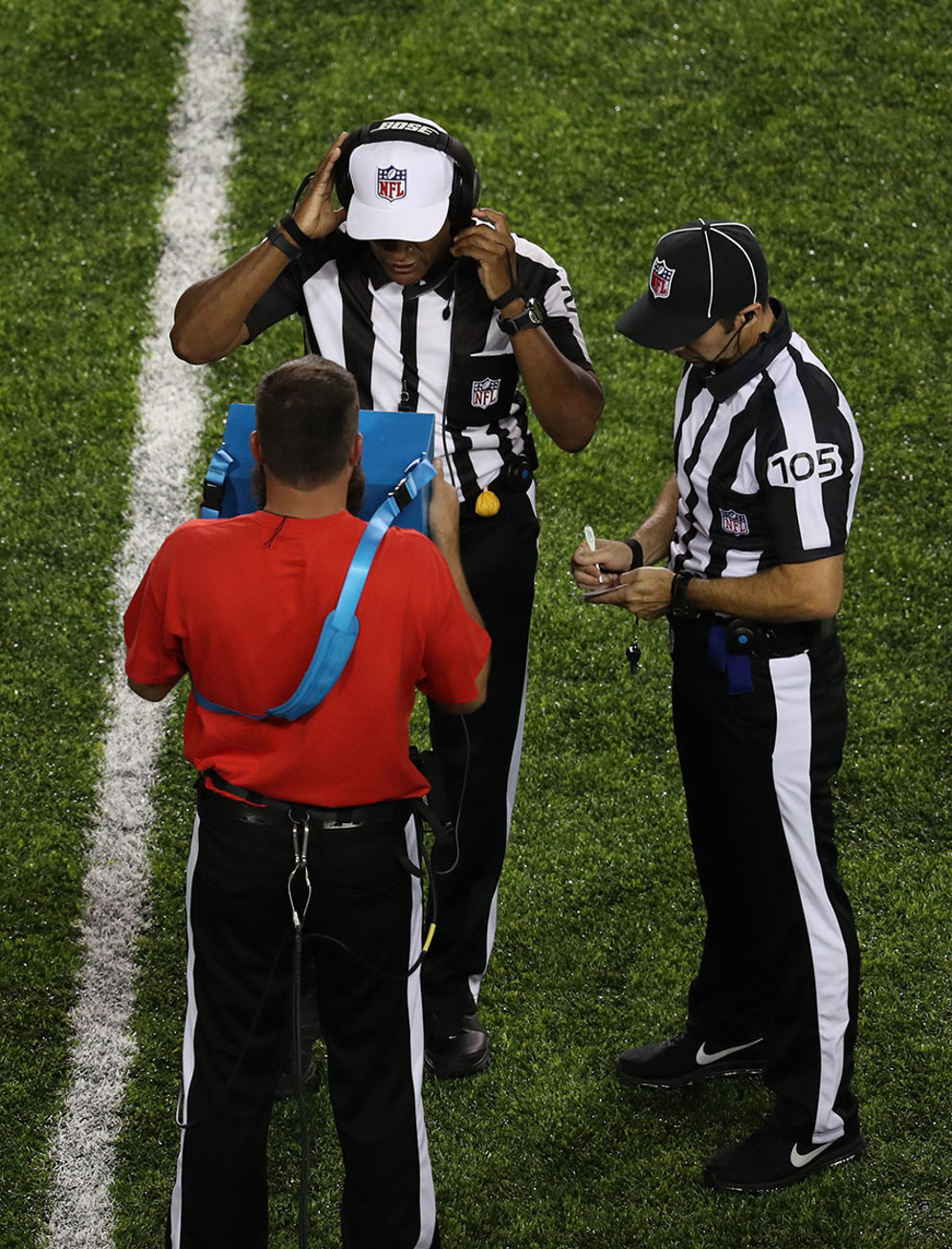
While the consultation model largely remains in place today, the Competition Committee voted to make two additional changes before the 2017 season. Final decisions on all replay reviews would come from designated senior members of the officiating section in AMGC and referees view all replay video on wired, hand-held Microsoft Surface tablets.
| Yr | Games | Total Plays Reviewed | Avg. Reviews/ Game | Total Plays Reversed | Percentage of plays reversed | Avg. Delay/ Review |
| 1999 | 248 | 195 | 0.8 | 57 | 29% | 2:54 |
| 2000 | 248 | 247 | 1.0 | 84 | 34% | three:05 |
| 2001 | 248 | 258 | ane.0 | 89 | 34% | three:04 |
| 2002 | 256 | 294 | i.1 | 94 | 32% | three:01 |
| 2003 | 256 | 255 | one.0 | 66 | 26% | 3:thirteen |
| 2004 | 256 | 283 | 1.1 | 88 | 31% | 3:18 |
| 2005 | 256 | 295 | 1.two | 92 | 31% | 3:sixteen |
| 2006 | 256 | 311 | 1.2 | 107 | 34% | 2:37 |
| 2007 | 256 | 327 | 1.three | 122 | 37% | 2:38 |
| 2008 | 256 | 315 | 1.2 | 117 | 37% | 2:xl |
| 2009 | 256 | 328 | 1.three | 126 | 38% | ii:39 |
| 2010 | 256 | 361 | one.four | 133 | 37% | ii:42 |
| 2011 | 256 | 390 | 1.5 | 172 | 44% | 2:30 |
| 2012 | 256 | 435 | 1.7 | 170 | 39% | ii:33 |
| 2013 | 256 | 423 | i.7 | 185 | 44% | 2:25 |
| 2014 | 256 | 439 | 1.vii | 151 | 34% | 2:thirteen |
| 2015 | 256 | 415 | ane.6 | 176 | 42% | 2:16 |
| 2016 | 256 | 345 | 1.4 | 149 | 43% | ii:25 |
| 2017 | 256 | 429 | i.vii | 196 | 46% | 1:44 |
| 2018 | 256 | 349 | 1.4 | 172 | 49% | 2:01 |
| 2019 | 256 | 417 | i.6 | 196 | 47% | ii:08 |
| 2020 | 256 | 364 | 1.4 | 198 | 54% | ii:26 |
| 2021 | 272 | 279 | one.three | 158 | 57% | 2:23 |
| 1999- 2021 | 5,880 | 7,754 | i.32 | 3,098 | forty% | 2:37 |
Chicago Bears president Ted Phillips said later the successful 1999 vote, "We don't know if it's the perfect arrangement."
The perfect system? The NFL may never findthe perfect system. Merely each yr, instant replay improves dramatically. Applied science has helped the league come a long fashion — from stopwatches, walkie-talkies and pagers. And technology will go along to better the process, allowing the league to make rulings correctly and consistently.
Source: https://operations.nfl.com/officiating/instant-replay/history-of-instant-replay/
0 Response to "Nfl Replay Review Incontrovertible Evidence on Scoring Plays"
Post a Comment